
Marine and Personal Watercraft Accident Reconstruction
Personal Watercraft and power boats are popular vessels found in lakes and open waterways across the country. They are easy to operate, and can provide an enjoyable family activity for hot summer days. The rise in popularity of PWC's is largely due to the advancements in technology of these small boats. With a high power-to-weight ratio, many PWC's are capable of carrying passengers, and even towing a water-skier or inflatable tube behind them.
Accident Reconstruction Services
Differences Between Personal Watercraft and Larger Power Boats
Small watercraft, such as personal watercraft (PWC) and jet skis, are fundamentally different from larger power boats in several ways that affect both operation and accident reconstruction:

1. Operator Position and Control
-
PWC operators typically sit or stand on the watercraft and steer using handlebars, similar to motorcycles or ATVs.
-
The operator is fully exposed to the environment, with little to no structural protection around them.
-
Larger power boats operate more like automobiles, with operators seated at a helm equipped with a steering wheel and throttle control.
-
Many larger boats have structural enclosures, cabins, or rails that provide some protection, and they often have the capacity to carry multiple passengers in addition to the driver, whereas PWC are usually limited to one passenger, if any
2. Steering and Propulsion Dynamics
-
PWC and jet skis rely on a high-velocity water jet expelled from the rear of the watercraft to provide both propulsion and steering.
-
Steering is accomplished by directing the jet of water, with changes in throttle affecting speed and maneuverability.
-
Larger boats are often steered with a rear-mounted rudder, although some larger jet boats use water jets for propulsion.
-
Understanding these differences is crucial when evaluating operator control, response times, and collision dynamics.
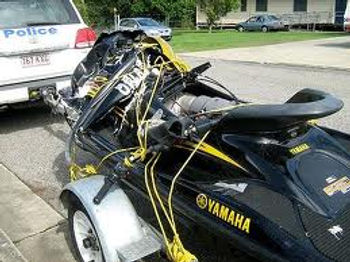

3. Handling and Maneuverability
-
PWC are highly nimble and responsive, allowing for sharp turns and rapid acceleration.
-
This responsiveness can be challenging for inexperienced operators who may underestimate hydrodynamic forces, wave impacts, or turning limitations.
-
Larger power boats have slower maneuverability but greater stability, which affects the way they respond to collisions or sudden changes in direction.
Personal Watercraft Accident Analysis
Accidents involving personal watercraft and small jet boats present unique challenges for forensic investigation:
-
Minimal physical evidence: Unlike land vehicles, PWCs leave no skid marks, tire impressions, or conventional indicators of speed or direction.
-
Operator inexperience: Many collisions occur because operators misjudge handling characteristics, fail to anticipate turning radius, or cannot effectively control acceleration and deceleration.
-
Environmental variables: Wave action, water currents, weather conditions, and operator posture all influence accident dynamics.
-
Veritech engineers have specialized knowledge of PWC dynamics, operator behavior, and product-specific performance characteristics. Our lead powersports expert brings 8 years of experience in the powersports industry, including product development and testing of PWCs, providing unparalleled insight into the design compromises, handling characteristics, and operational limitations of these watercraft.
Why Choose Veritech for PWC and Power Boat Accident Reconstruction
Veritech’s team offers comprehensive forensic analysis for watercraft accidents, including:
-
Personal watercraft (jet ski) accidents
-
Small recreational power boats
-
Jet boat collisions and navigation incidents
-
Operator error analysis and environmental factor evaluation
Our engineers combine hands-on operational knowledge, mechanical expertise, and accident reconstruction science to provide accurate, court-qualified reports. By analyzing propulsion dynamics, steering response, and watercraft design, Veritech ensures reliable reconstruction of accidents involving PWCs and power boats.